Notes:
What we learned in theory class as a 'half-diminished 7 chord' shown as ø7, will be labeled here within, as m7(♭5)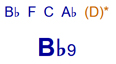 If a note appears in the spelling that you did not enter, and it is in parentheses and a different color, as is the D in this example, it is to indicate that the chord symbol displayed assumes that the 3rd (shown) is Major.
 into a chord ... or chord symbol ... or some nonsense. The point and hope for this is that a student can come home and check out his/her part, or homework, or latest discussion with his/her theory buddies, and get the notes to the chords right.
A few of the lines we drew are:
- If there is no 3, no 5, AND no 7, it is not a chord.
- If the same alphabet is included more than once, for example, G AND G♭ or D AND D♯, it is not a chord.
- If there are more than one set of neighboring half-steps, it is not a chord. This was a hard line to draw because Cmaj7(♯ 11) is a favorite chord and it qualifies: C noodging B, and G noodging F#. But we had to draw the line and that's where we drew it, for reasons not worth going into here ... but you can give me a call if you want to talk about it. 603.242.2898 or send an email.
We first posted Name That Chord in 2019, with Stump the Chordmaster the last section to be built. It was designed to count half-steps to determine the chord structure/symbol.
It worked.
Except that it didn't. B D♯ G came back as B+.
Which is correct.
Except that it isn't. B+ is B D♯ F𝄪
It was driving me crazy so I sat down to do it over.
Maybe .... I could have done this without Claude, maybe. But it would have taken me weeks if not months to do what we did in four days. I found the collaboration to be easy and reciprocal, and in the end I was relieved to realize that I couldn't have done it without Claude, but darn it, Claude couldn't have done it without me!
That AI is not (yet) omnipotent or all-knowing - or not able to foresee some things that are clear to me, is reassuring. For now anyway. So, 'we' have worked hard to make this perfect within limits. Please let me know if you find a discrepancy.
-Steve